Technology
TECHNOLOGYConceiving the structure and weaving it steadily, day after day, are two different things. The loom, the people, and the know-how held between them.
What is Karami weaving?
WHAT IS KARAMI?In Karami weaving, the warp threads cross from side to side and close around the weft as the cloth forms. Because the threads themselves hold the weave in place, the fabric can be left open without slipping — delicate transparency and structural stability at once. The coolness and grace it lends to traditional dress rests on a precise construction that keeps those openings, letting light and air pass through.
A different structure
STRUCTUREIn an ordinary weave the warp threads stay parallel and do not move. In Karami weaving they exchange places, left and right, closing around the weft. That single difference produces a cloth that can be opened up without falling out of line.
An ordinary weave. The warp stays parallel.
Karami weave. Warp threads cross, trapping the weft.
A schematic of how the warp threads move. It does not represent actual thread thickness or density.
STRUCTURE
構造
The technical heart of Karami weaving is a weave structure in which the warp threads cross one another while holding the weft in place. In an ordinary weave, lowering the thread density lets warp and weft shift and the weave slip out of line. Here the threads lock each other's positions, so the structure holds even with large openings. Opening up space while remaining a stable cloth — this is what separates Karami weaving from a plain weave or a netted material.
A schematic of the Sha, Ro and Ra structures, showing how a pair of warp threads changes sides around the weft. It does not represent actual thread thickness or density.
Not every textile should be woven faster.
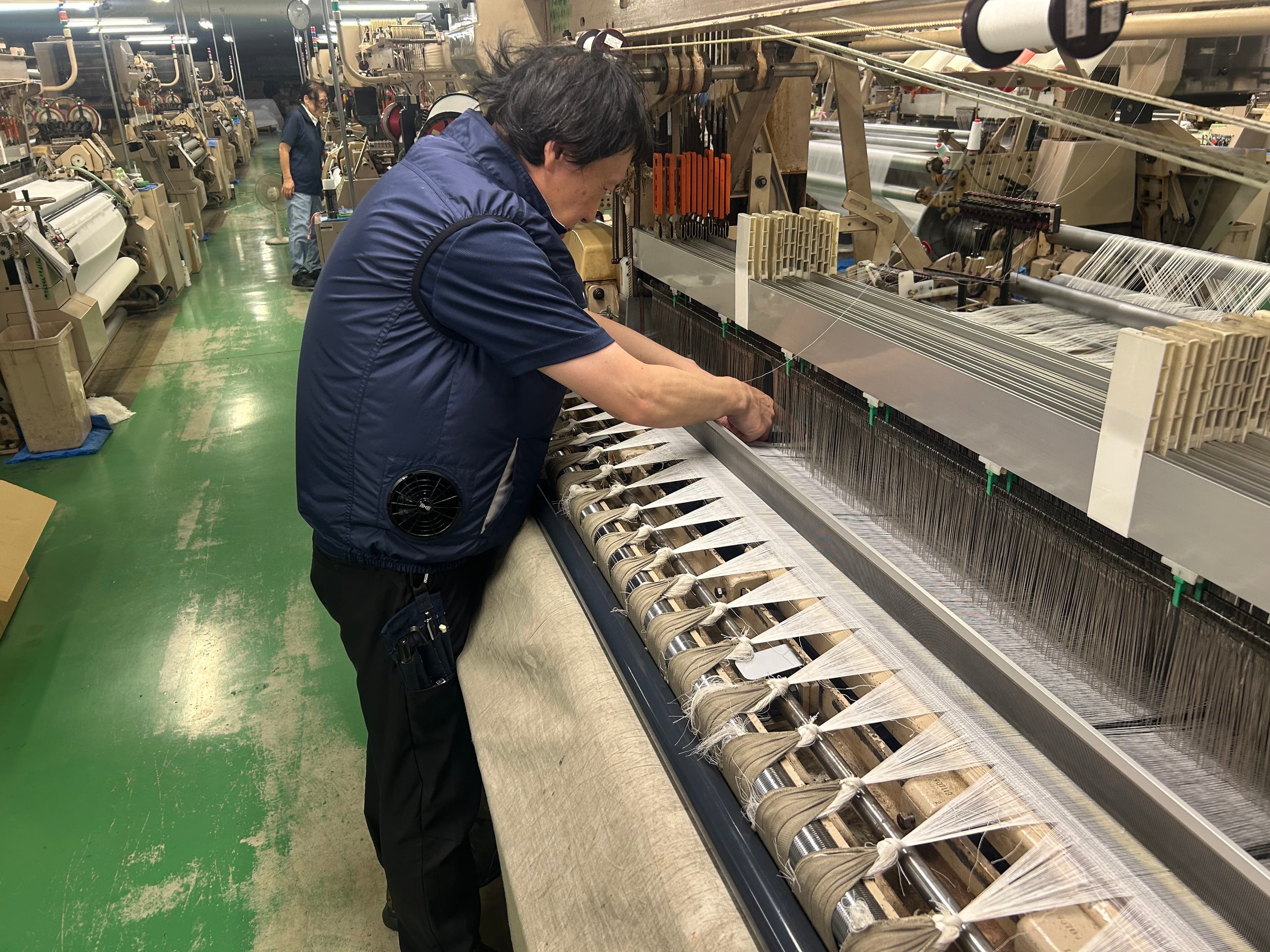
THE LOOMBecause the warp threads move in a highly specific way, Karami weaving requires loom settings and techniques that differ from standard weaving — including, deliberately, a slower rotation speed.
This is not the slowness of an old machine. It is the movement required to build a genuinely complex structure.
Technical details
TECHNICAL DETAILSTHE DIFFICULTY
The difficulty hidden in a sheer cloth
What draws people to Karami weaving is the fine, open weave that lets light and air through. That lightness of appearance comes from a distinctive structure in which the warp threads cross one another. Follow the movement of the threads, and the skill needed to go on weaving this cloth begins to show.
CROSSING
A warp thread moves to the other side of its neighbour
In a plain weave and other basic constructions, the warp is divided above and below and the weft passes between. In Karami weaving a further movement is added: warp threads exchange places, left and right. One thread wraps around its neighbour, crossing it and trapping the weft. This crossing is what holds an open weave in place.
The mechanism that guides it is the doup heddle (karami sōkō) and other purpose-built parts.
THREAD PATH
The same length of cloth, different distances travelled
A thread that runs straight and a thread that wraps around its neighbour are woven into the cloth at different lengths. That difference also affects how tightly each is held.
In Karami weaving, the difference in take-up and tension that arises under the tanshiki (single-doup) method is described as calling for the warp to be wound on two separate beams. Keeping the thread path simple, and reducing friction against the guides, is also needed to limit fraying and breakage.
Alongside designing the weave structure, one has to settle where the thread is fed from, how much of it, and along which path it moves.
TENSION
A thread breaks when it slackens, too
Thread breakage brings to mind a thread pulled too hard. In Karami weaving, however, slack leads to breakage as well: a loose warp thread catches between the heddles and snaps. Hold the thread taut; do not obstruct the movement it has to make; do not let it go slack. That balance has to be found again for each material.
TORSION
Even the twisting force shapes the finished cloth
Crossing the warp puts a twisting force into the thread. That force bends the weft and shapes the cloth in three dimensions.
From a sheer open weave to a cloth that holds space within it: the possibilities of Karami weaving are bound up with the skill of handling the forces the threads are under.
PATTERN
One pattern, many movements hidden inside it
There is a reconstruction study that speaks to how complex Karami weaving can be.
A 2025 paper in npj Heritage Science on ancient Chinese leno weaves examined loom mechanisms and threading in order to reproduce a structure in which threads also cross with the neighbouring pair. In the diamond-patterned cloth the study reconstructed, nine heddle shafts were used, and one repeat of the pattern took the movements of twenty-two weft picks.
This is one particular historical textile, but it shows how much sequencing of thread movement and mechanical design is packed into a pattern that looks, at a glance, quiet.
STABILITY
Complexity in the weaving becomes stability in use
In the finished cloth, the structure of crossed threads works to stop the threads from shifting.
A 2025 paper in Cellulose compared, among others, a four-end leno structure in cotton yarn. In samples compared at the same warp and weft density, the leno cloth required greater force than plain weave when a thread was pulled out. The researchers relate this behaviour to a "self-locking effect" produced by the crossing of the threads: a structure that holds its openings while the threads support one another.
Put another way, the difficulty of Karami weaving lies in getting thread placement, tension, friction and the order of movements right all at once. To weave continuously under automation, those conditions have to hold within a repeating motion, pick after pick.
In a single sheet of cloth that lets light through, there is layered knowledge: of the nature of the thread, of setting the movement of the machine, of holding the weave steady. Only by inheriting that knowledge too can the next length be woven.