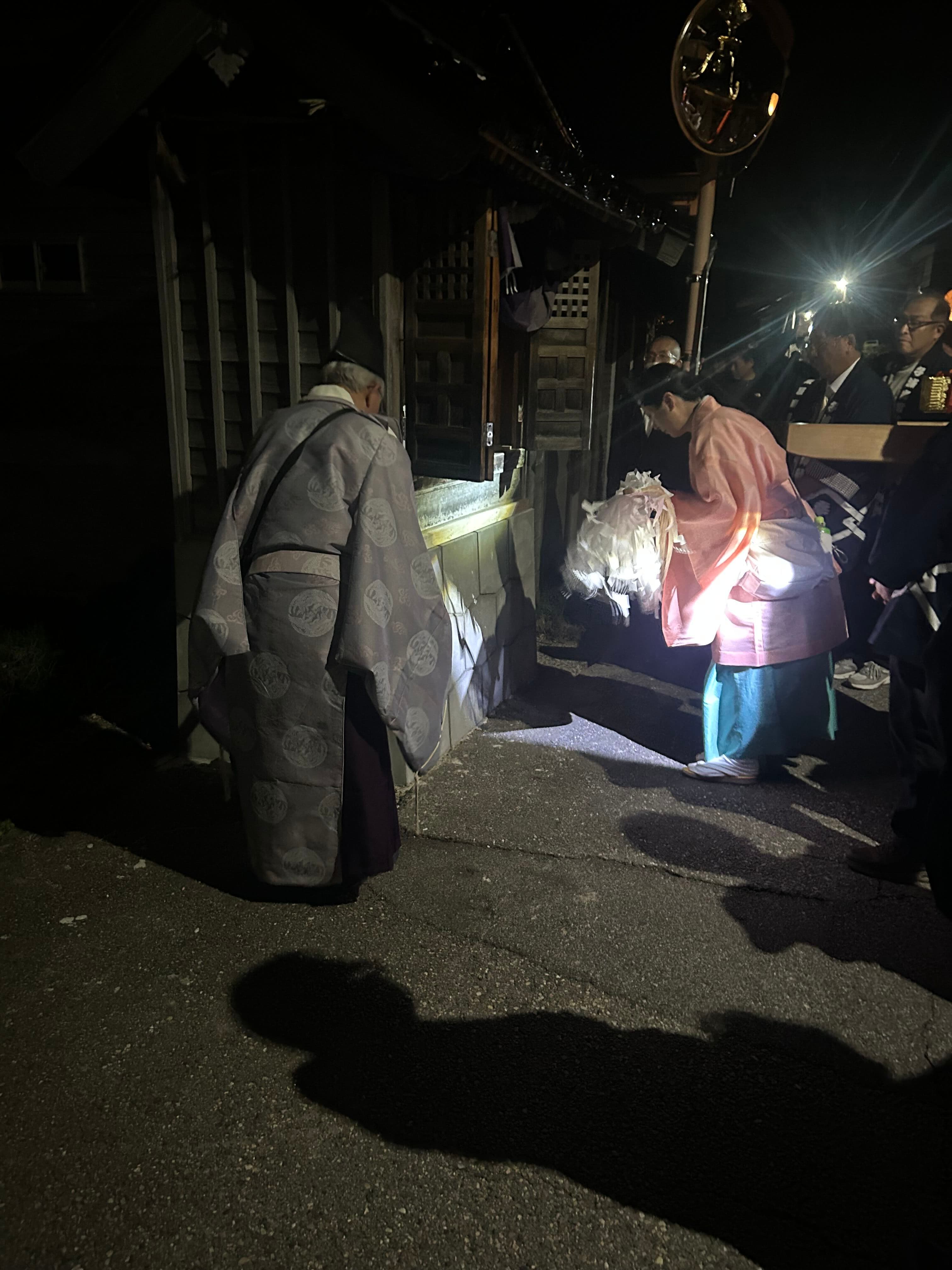
Hakui Grand Festival and the eboshi worn by Shinto priests
On September 19 and 20, 2026, Hakui Grand Festival took place around Hakui Shrine.
Alongside the portable shrines and rituals, the festival offers a chance to see Shinto priests in traditional ceremonial dress. One distinctive element is the black headwear known as eboshi.
Eboshi have been worn by men in Japan since ancient times. Their materials and methods of construction have varied, but their history includes the use of a fine silk textile called Ra (complex gauze weave).
Ra is more than a thin, translucent fabric. It has a particularly intricate structure within the family of karami (leno) weaving. This historical connection does not establish the material of the eboshi shown in the photograph.
Ra: an especially complex form of karami weaving
In Ra, multiple warp threads cross neighbouring threads, changing their combinations to form a net-like structure.
Rather than simply creating uniform gaps, changes in the way the warp threads cross can vary the size and shape of the openings. More elaborate forms can produce diamond patterns and other motifs through the crossings themselves.
The pattern is not applied to the surface after weaving. The way the threads cross creates both the pattern and the fabric’s transparency.
Warp threads must move in complex sequences while the weft passes between them to form a continuous cloth. Ra therefore requires particularly advanced weaving skills within the karami family.
A precious luxury textile in ancient Japan
Ra has a long history and was already used in Japan during the Asuka and Nara periods.
Ancient Ra cannot be understood only as a lightweight fabric for keeping cool. Manipulating fine silk threads into a stable textile while leaving large, net-like openings demanded considerable skill. Changing the crossings could also create patterns within the open fabric itself.
Ra was consequently valued as a precious silk textile alongside nishiki brocades and aya twills. Examples of Ra made during the Nara period survive in the Shōsōin collection.
Its value did not lie simply in using fewer threads. It lay in the complex control of those threads: creating empty space within a cloth while preserving its structure.
Ra woven in Hakui today
Today, TECHNOWIN in Hakui also manufactures textiles known as Ra.
The Ra historically used for eboshi and other purposes is not necessarily a textile of exactly the same specifications as the Ra woven by TECHNOWIN today.
Ra takes many forms according to its yarn, density, weave structure and intended use. Nevertheless, the principle of crossing multiple warp threads to create space and structure can also be seen in contemporary karami weaving.
Once a precious luxury silk textile, Ra survives in the Shōsōin collection. At the 2026 Hakui Grand Festival, visitors could see eboshi: an element of Japanese dress with a historical connection to Ra.
In the same city today, TECHNOWIN continues to weave karami textiles, including Ra. This does not imply an unbroken local transmission of ancient Ra techniques, or that the ancient and modern fabrics are identical.
Karami weaving remains a living craft in Hakui.