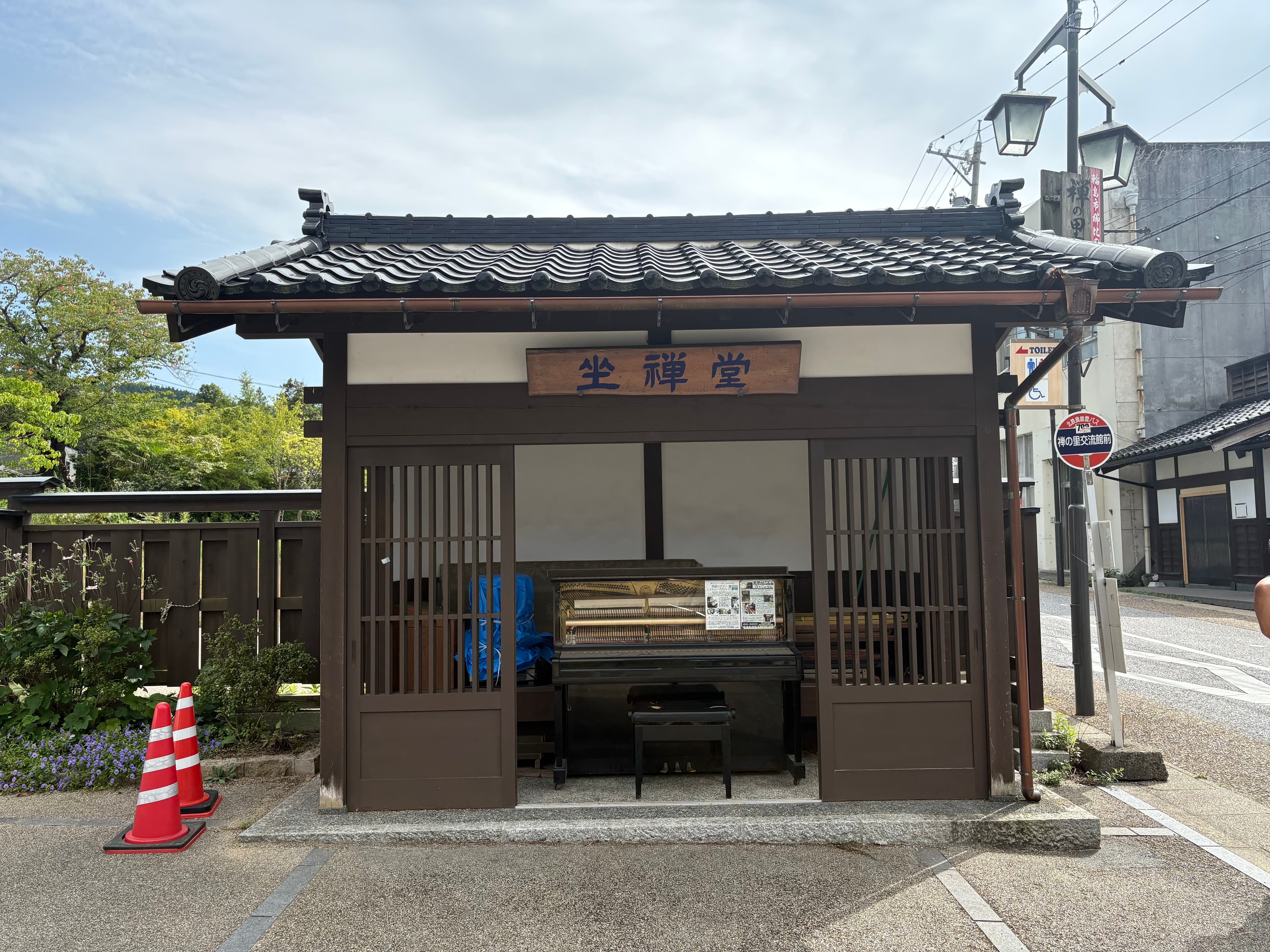
Sōtō is a school of Zen Buddhism that places seated meditation, or zazen, at the heart of its practice.
Japan’s Zen traditions include Sōtō and Rinzai. Within Sōtō, zazen itself has been especially valued as practice.
At Zen no Sato in Monzen, Okunoto, visitors can learn why Sōjiji, one of Sōtō’s two head temples, was established in this region and how it developed. This is the history connected with present-day Sōjiji Soin.
Sōtō has two head temples: Eiheiji in Fukui Prefecture and Sōjiji, now in Tsurumi, Yokohama.
Why does one school have two head temples?
Dōgen, who brought the Sōtō tradition to Japan, founded Eiheiji in Echizen in 1244.
Central to Dōgen’s teaching was shikantaza — just sitting. Zazen was not merely a means of attaining enlightenment; sitting itself was practice. This remains fundamental to Sōtō today.
About eighty years later, Keizan Jōkin, an inheritor of Dōgen’s teaching, founded Shogakuzan Sōjiji in Noto in 1321.
According to a tradition preserved at Sōjiji, an imperial decree from Emperor Go-Daigo the following year recognised the temple as “Sōtō shishi shusse daiichi no dōjō.”
Sōjiji grew considerably, and through Keizan and his disciples, Sōtō Zen spread across Japan.
Here we can see a difference in the historical character of the two temples.
Eiheiji became a centre of rigorous training grounded in shikantaza.
Sōjiji developed as a base for bringing Zen teachings into wider society.
Of course, zazen is also fundamental at Sōjiji. Shikantaza is not exclusive to Eiheiji: it belongs to the foundations of Sōtō as a whole.
Historically, Eiheiji served as a centre for preserving and deepening Dōgen’s teaching and practice. Sōjiji trained many disciples who travelled to different regions, helping to spread the Sōtō tradition throughout Japan.
Eiheiji: deepening the teaching inwardly.
Sōjiji: carrying the teaching outward.
These are different historical emphases, not a division between meditation and outreach. Both head temples developed from the same foundation in Zen.
And the place where one of them, Sōjiji, began is Noto.